
Most Fuel Efficient Tow Vehicles In Australia For A 3,000kg Caravan (Real Data 2026)
Owning one of the most Fuel Efficient Tow Vehicles In Australia for towing a 3,000kg Caravan is a great way to save some money – particularly in 2026. Choosing the right tow vehicle isn’t just about power – it’s about real world fuel efficiency under load. Once you hitch up a 3,000kg caravan, fuel consumption can increase by as much as 40 – 80% compared to manufacturer figures.
For Australian travellers planning big laps or remote touring this difference can mean thousands of dollars in fuel costs every year. In this guide, we break down real world towing data, compare the most efficient vehicles, and show exactly what to expect when towing a 3-tonne caravan.
Real World Fuel Consumption When Towing 3,000kg
Manufacturer fuel economy figures are tested without load. Once towing, the numbers change significantly.
- Diesel utes: 12 – 15L/100km (highway), up to 20L/100km urban
- Diesel SUVs: 14 – 17L/100km
- Large diesel wagons: 18 – 22L/100km
- Petrol V8 SUVs: 18 – 28L/100km
Key takeaway: Diesel vehicles are typically 25 – 40% more fuel efficient than petrol when towing heavy caravans.
Why Diesel Vehicles Are More Efficient for Towing
- Higher torque at low RPM
- Less engine strain under load
- Better fuel economy over long distances
This is why most serious towing setups in Australia – especially for 3,000kg caravans – use diesel engines.
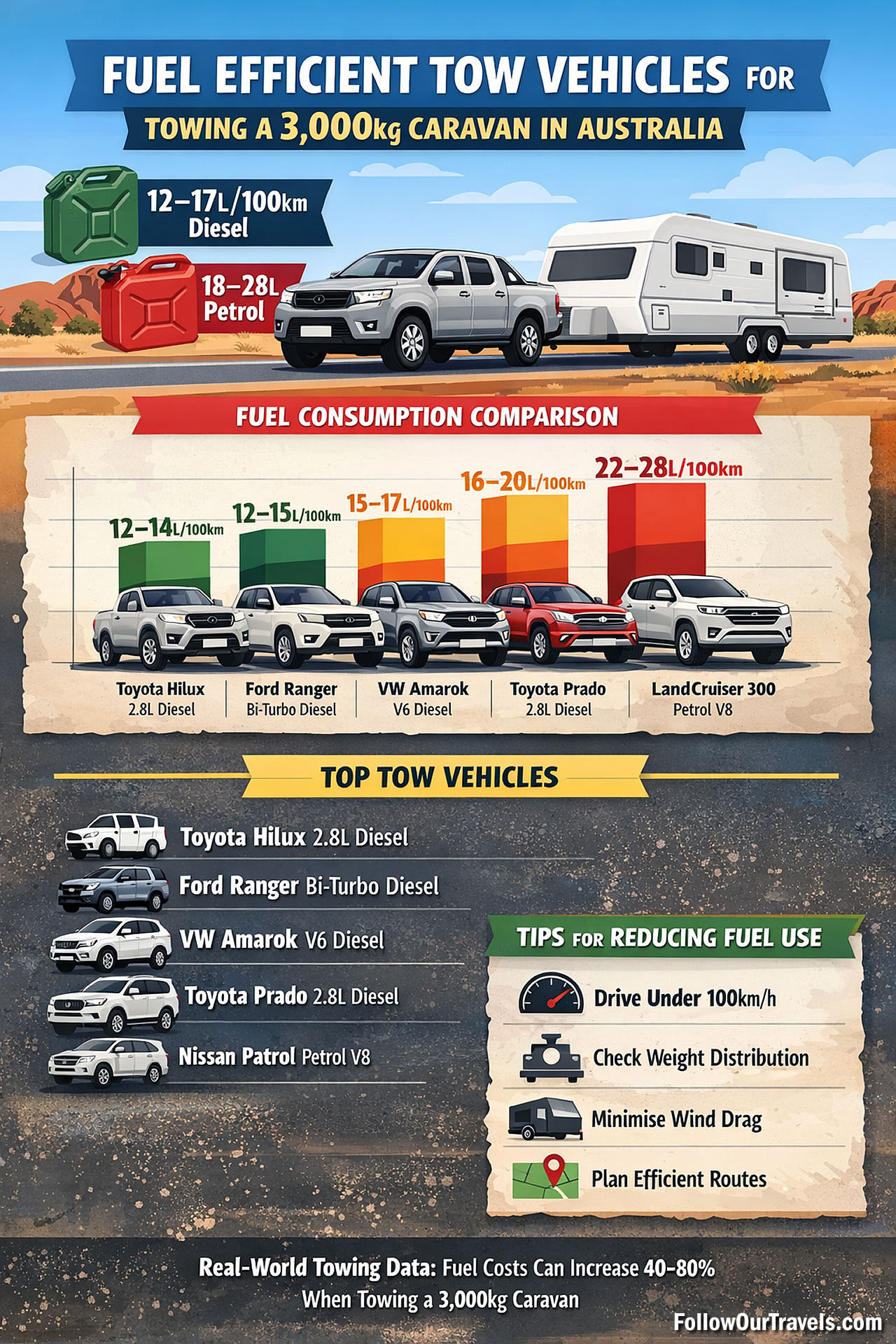
Most Fuel Efficient Tow Vehicles In Australia Infographic
Most Fuel Efficient Vehicles for Towing 3,000kg
Toyota HiLux (2.8L Turbo Diesel)
- Claimed: 7.1L/100km
- Real towing: 12 – 14L/100km
- Towing capacity: 3,500kg
“Towing our 3-tonne van, we averaged about 13L/100km on the highway in our HiLux. Headwinds push it higher, but overall very manageable.”
– Vincent & Maria / Mansfield VIC
Ford Ranger (2.0L Bi-Turbo Diesel)
- Claimed: 7.2L/100km
- Real towing: 12–15L/100km
- Towing capacity: 3,500kg
“Our Ranger sits around 13–14L/100km towing. Hills or towns push it closer to 16L.”
– Ben & Sam / St Marys NSW
Volkswagen Amarok (Diesel)
“Towing our 3-tonne caravan with the Amarok V6, we usually sit around 15 – 17L/100km on the highway. It’s really stable and doesn’t feel like it’s working hard even on long runs.”
– Kevin & Deb / Goolwa SA
Independent towing tests show the Amarok uses around 15 – 17L/100km when towing a 3,000kg caravan under real world conditions (Caravan Camping Sales tow test).
Toyota Prado (2.8L Diesel SUV)
- Claimed: 8.5L/100km
- Real towing: 14 – 17L/100km
- Towing capacity: 3,500kg
“The Prado averages about 15 – 16L/100km towing our van. Not the cheapest, but very comfortable.”
– Khoa / Bankstown NSW
Toyota LandCruiser 300 Series
- Real towing: 16 – 20L/100km
- Towing capacity: 3,500kg
“LandCruiser uses about 18L/100km towing. Effortless, but definitely more fuel.”
– Steven & Maxine / Ipswich QLD
Nissan Patrol (Petrol V8)
- Real towing: 22 – 28L/100km
- Towing capacity: 3,500kg
“Patrol is powerful but thirsty – around 24 – 26L/100km towing our caravan.”
– Jason & Tilly / Bunbury WA
Fuel Efficiency Comparison Table (3,000kg Caravan) – Fuel Efficient Tow Vehicles In Australia
| Vehicle | Engine | Power/Torque | Claimed Economy | Real Towing | Fuel Tank | Range (Towing) |
|---|---|---|---|---|---|---|
| Toyota HiLux | 2.8L Diesel | 150kW / 500Nm | 7.1L/100km | 12 – 14L/100km | 80L | 570 – 660km |
| Ford Ranger | 2.0L Diesel | 154kW / 500Nm | 7.2L/100km | 12 – 15L/100km | 80L | 530 – 660km |
| VW Amarok | Diesel | Up to 600Nm | 7.2L/100km | 12 – 15L/100km | 80L | 530 – 660km |
| Toyota Prado | 2.8L Diesel | 150kW / 500Nm | 8.5L/100km | 14 – 17L/100km | 150L | 880 – 1070km |
| LandCruiser 300 | 3.3L Diesel | 227kW / 700Nm | 8.9L/100km | 16 – 20L/100km | 110L | 550 – 680km |
| Nissan Patrol | 5.6L Petrol | 298kW / 560Nm | 14.4L/100km | 22 – 28L/100km | 140L | 500 – 630km |
Real Owner Fuel Consumption (Australia) – Fuel Efficient Tow Vehicles In Australia
“Towing our 3-tonne van, we averaged about 13L/100km on the highway in our HiLux. Headwinds push it higher, but overall very manageable.”
– Vincent & Maria / Mansfield VIC
“Our Ranger sits around 13 – 14L/100km towing. Hills or towns push it closer to 16L.”
– Ben & Sam / St Marys NSW
“The Prado averages about 15 – 16L/100km towing our van. Not the cheapest, but very comfortable.”
– Khoa / Bankstown NSW
“LandCruiser uses about 18L/100km towing. Effortless, but definitely more fuel.”
– Steven & Maxine / Ipswich QLD
“Patrol is powerful but thirsty—around 24 – 26L/100km towing our caravan.”
– Jason & Tilly / Bunbury WA
“Towing our 3-tonne caravan with the Amarok V6, we usually sit around 15 – 17L/100km on the highway. It’s really stable and doesn’t feel like it’s working hard even on long runs.”
– Kevin & Deb / Goolwa SA
Real-world owner reports also show variability depending on wind and terrain, with some drivers reporting figures between 15–21L/100km when towing heavy loads (example discussion).
Most Fuel Efficient Tow Vehicles In Australia
Fuel Cost Comparison
Over a 5,000km trip:
- Diesel ute (13L/100km): 650L fuel
- Petrol V8 (24L/100km): 1,200L fuel
This means petrol vehicles can use nearly double the fuel over long trips.
What Affects Fuel Consumption When Towing?
- Caravan aerodynamics
- Speed (above 100km/h increases fuel use significantly)
- Terrain and wind conditions
- Weight distribution and setup
Data Sources
- Caravan Camping Sales Tow Test
- CarsGuide Fuel Data
- CarsGuide Towing Capacity
- Owner Reports (Australia)
Final Verdict On Fuel Efficient Tow Vehicles In Australia
When towing a 3,000kg caravan in Australia:
- Diesel: 12 – 17L/100km
- Petrol: 18 – 28L/100km
Choosing the right tow vehicle can save thousands of dollars in fuel and significantly extend your touring range.
Fuel Efficient Towing Vehicles – Common Questions Answered
What is the most fuel efficient vehicle for towing a caravan?
Which diesel SUVs offer the best fuel economy when towing?
Does towing significantly increase fuel consumption?
Are hybrid vehicles suitable for towing caravans or boats?
What factors affect fuel efficiency when towing heavy loads?
How can I improve fuel economy while towing long distances?