
Old Peake Telegraph Station: Comprehensive Guide (2026)
Visiting the Old Peake Telegraph Station on the Oodnadatta Track? Here’s what to expect, how to get there, and why it’s worth the detour.
Amanda and I have visited the Old Peake Telegraph Station twice now. Once in 2016 and again in 2022. Both times the peace and quiet was surprising. For a place that at one time was obviously very busy it now stands silent. There’s no traffic noise, no phone signal and no crowds. Just old stone, rusted iron and a story that was a part of how Australia talked to the rest of the world.
If you’re planning a lap of the Oodnadatta Track in South Australia this old repeater station deserves a stop. Below we’ll cover its history, how to get there, what changed between our visits and whether the detour is worth your time and fuel (spoiler alert – it is).
A Short History Of The Peake Telegraph Station
The Overland Telegraph Line linked Adelaide to Darwin in 1872, connecting Australia to London by cable for the first time. Before this news took months to arrive by ship. After the line opened a message could reach London in about a day. That’s the kind of leap this project represented.
The Peake was one of twelve repeater stations built along the route. Workers used around 36,000 poles and 3,200 kilometres of wire to complete the whole line according to the State Library of South Australia. The site sits on land explorer John McDouall Stuart passed through in 1859. He named the nearby creek after parliamentarian Edward John Peake.
Before the telegraph arrived the area had already served as a pastoral run since the late 1850s. Once the railway line shifted the main route in the 1890s the station lost its purpose. Operations later moved to William Creek and the buildings were left to the weather.
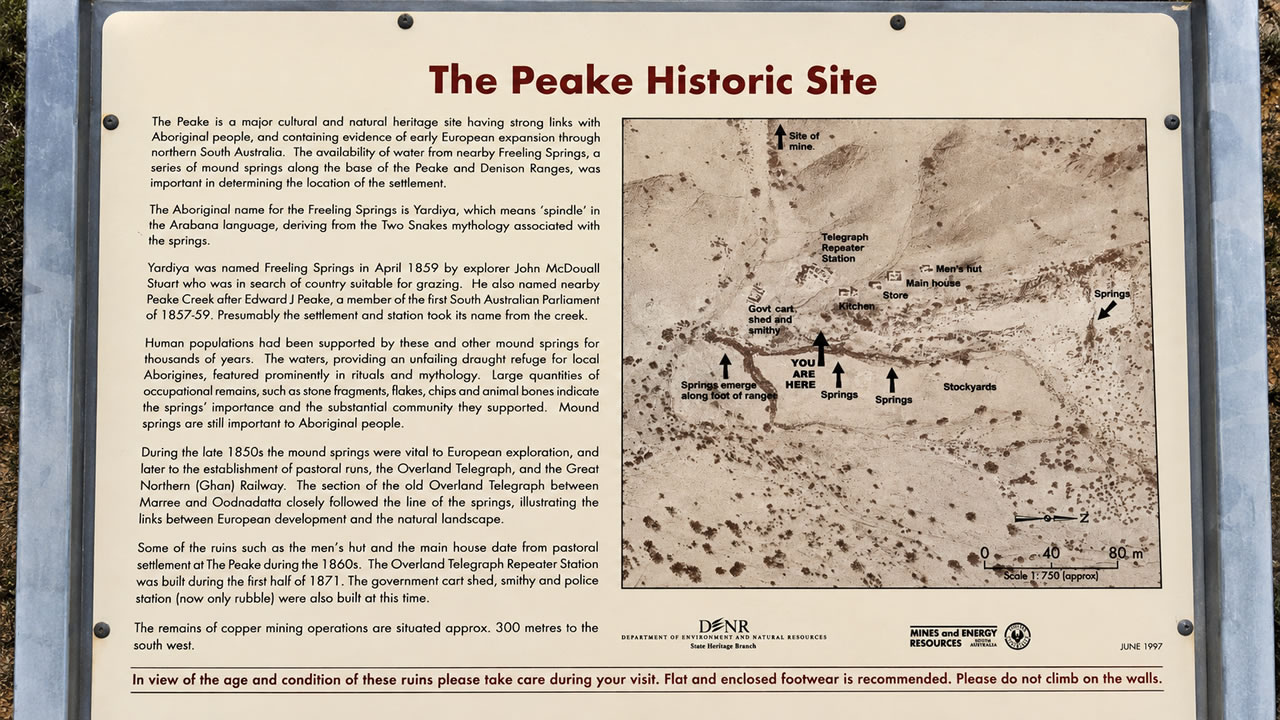
The Peake Historic Site Information Board
Old Peake Telegraph Station Today
Heritage SA has stabilised and partly restored the stone ruins, according to the Department for Environment and Water. You’ll find the old station buildings, the remains of a small settlement and the nearby Copper Top mine.
Camping is no longer permitted at the site itself – so plan to visit as a day stop rather than an overnight base. This is a change worth noting if you’re using an older guidebook that mention camping there.
Walks At The Old Peake Telegraph Station
- The Copper Top Smelter and Mine Walk walking track follows the creek line past the ruins. This walk took us about 2 hours to complete however we’re not exactly prime physical specimens these days!
- The Settlement Walk takes you through the ruins of the Overland Telegraph Station and pastoral station. Building are marked with interpretive signage (allow about an hour).
- The Creek And Cemetery Walk allows you to easily explore the plants along the creek (usually dry) and ends up with a walk through the small cemetery (allow about 45 mins)
Wear comfortable walking shoes, a hat and bring plenty of drinking water if going on any of the walks.
Comparing Our 2016 And 2022 Visits
We noticed a few differences between our two trips. Nothing dramatic, but useful if you’re weighing up whether a return visit is worthwhile.
| Detail | 2016 Visit | 2022 Visit |
|---|---|---|
| Access track condition | Rough, corrugated, slow going | Similarly rough, some fresh grading in patches (could have been my imagination too!) |
| Signage and interpretation | Minimal | Improved interpretive signs at the ruins |
| Camping | Informal camping still common nearby | Camping at the site no longer allowed |
| Mobile signal | None | None |
| Time needed on site | About 90 minutes | Closer to 3 hours, with the mine walk included |
The core experience hasn’t shifted much. Stone walls, red dirt, and a sense of scale that’s hard to get from photos alone.
Getting There From The Oodnadatta Track
The turn-off sits roughly 111 kilometres north of William Creek, or about 95 kilometres south of Oodnadatta, depending which direction you’re travelling. From there, a side track runs east for somewhere between 16 and 25 kilometres to reach the ruins, with sources giving slightly different distances. Either way, budget close to an hour each way.
This side track is 4WD only. High clearance matters here, since the track twists through the base of the Denison Ranges with several creek crossings along the way. A caravan or camper trailer will slow you down considerably, so many travellers unhitch before heading in if they can find a safe spot to leave their rig.
Before setting off, check current conditions. Outback roads in this part of South Australia can close quickly after rain. Call 1300 361 033 for the automated road report, or check the SA outback roads conditions page before you commit fuel and time to the detour.
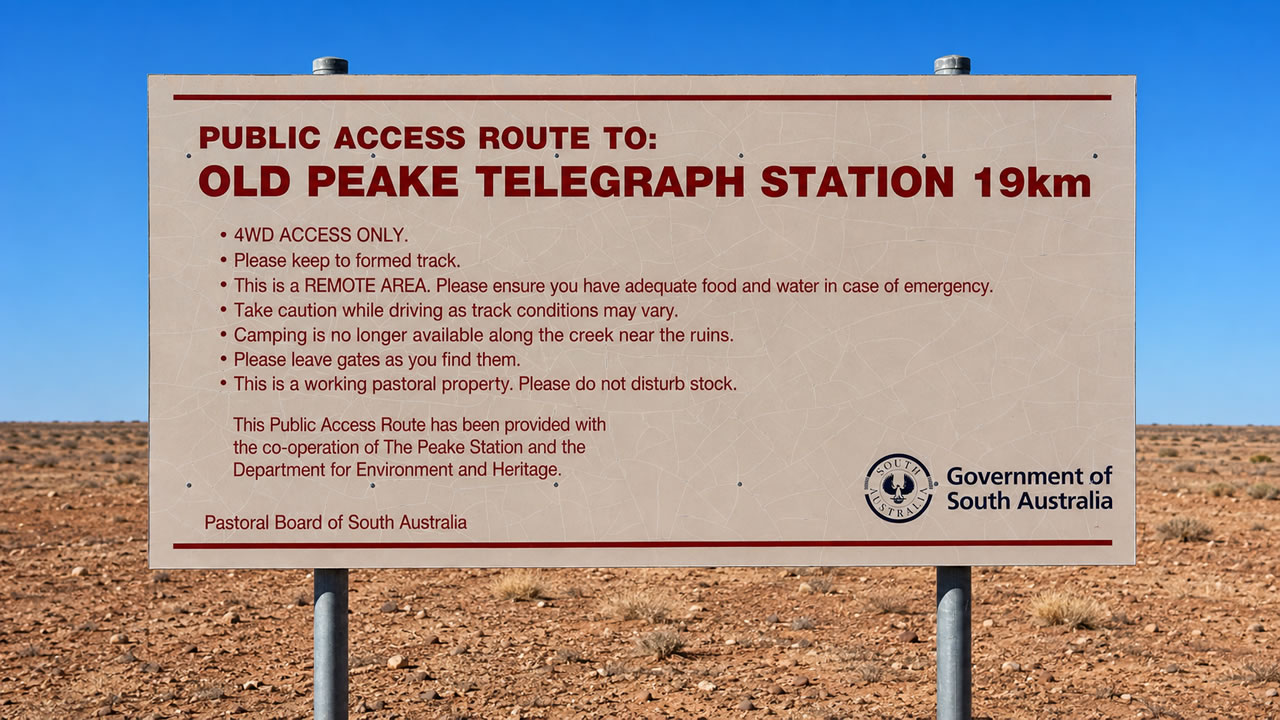
Old Peake Telgraph Station Public Access Route Sign
Old Peake Telegraph Station Versus Algebuckina Bridge
Travellers heading up the Oodnadatta Track often compare the Peake ruins with Algebuckina Bridge, another well known stop further north. Both sit just off the main track, and both connect to the old Ghan railway era. Here’s how they differ.
| Feature | Old Peake Telegraph Station | Algebuckina Bridge |
|---|---|---|
| Detour length | 16 to 25 km, 4WD only | On the main track, minimal detour |
| Time on site | 1.5 to 2 hours | 30 to 45 minutes |
| Camping allowed | No | Yes, near the waterhole |
| Historical focus | Telegraph repeater station and mining | Railway engineering |
| Difficulty | Slow, rough, best done unhitched | Easy, accessible to most vehicles |
If your time is short, Algebuckina is the easier stop. If you want a quieter, more remote experience and don’t mind the extra driving, the Peake ruins offer something the main track doesn’t. To be honest though if you can then visit both. Algebuckina Bridge has fantastic free camping available, so if it was me planning then I’d visit Old Peake Telegraph Station and camp at Algebuckina Bridge.
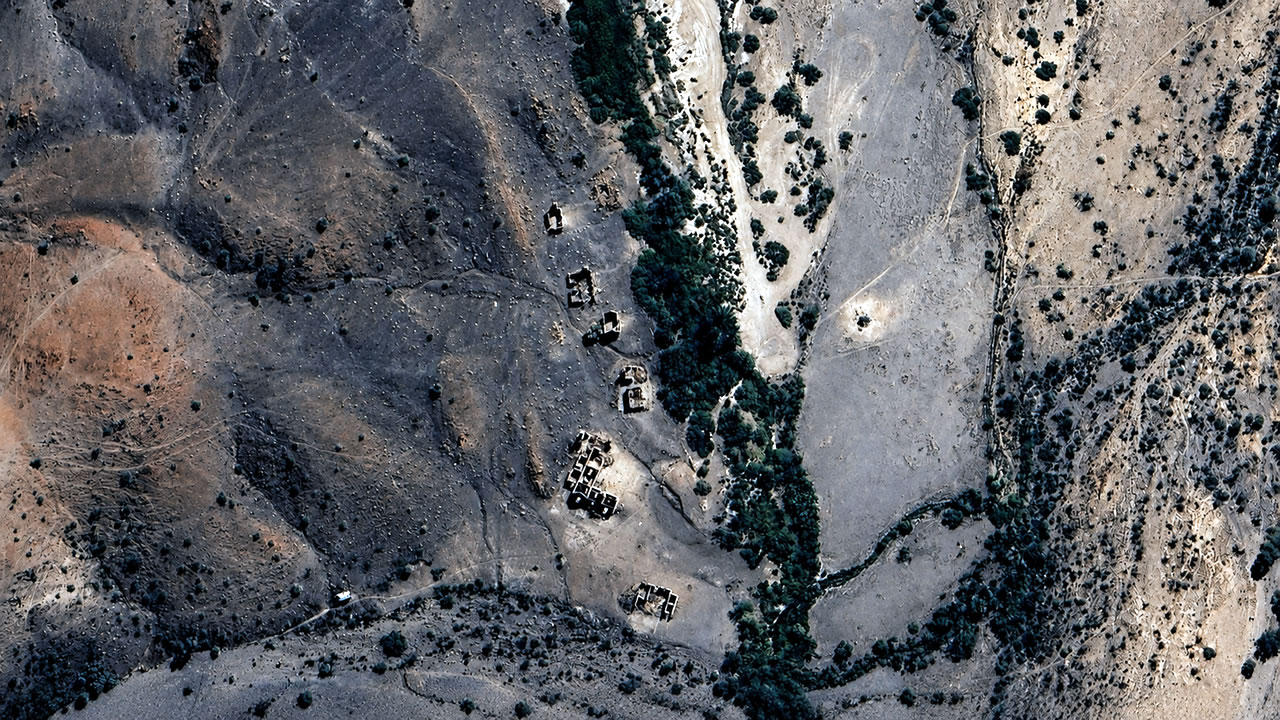
Old Peake Telegraph Station
Tips For Caravanners And Campers In May 2026
May sits within the recommended travel window for the Oodnadatta Track, running roughly from May through September. Daytime temperatures are far more manageable than the summer months, when conditions above 45°C are common and can turn dangerous if your vehicle breaks down.
A few points to keep in mind before you go:
- Carry extra water beyond what you think you’ll need. There’s no fuel or water at the Peake site.
- Reduce tyre pressure before the side track, and reset it once you’re back on the main road.
- Fuel up at William Creek or Oodnadatta, since both towns sit well apart from each other.
- Pack a satellite communication device or personal locator beacon. Mobile coverage does not reach this stretch of the track.
- Leave your caravan at a safe pull off spot before tackling the access road, unless you’re confident with rough towing.
Final Thoughts
The Old Peake Telegraph Station won’t suit every itinerary. It takes time, a capable vehicle, and a bit of patience with corrugations. In return, you get a genuine slice of colonial era engineering sitting quietly in the desert, largely untouched by tourism infrastructure.
Amanda and I keep returning to places like this because they change slowly enough that each visit still feels worth the drive. Six years between our two trips, and the ruins told the same story, just with a little more signage to help along the way.
FAQs – Frequently Asked Questions About Old Peake Telegraph Station
Is the Old Peake Telegraph Station worth visiting?
Can you camp at the Old Peake Telegraph Station?
Do I need a 4WD to visit Old Peake Telegraph Station?
How far is Old Peake Telegraph Station from the Oodnadatta Track?
How much time should I allow for a visit?
Is there mobile phone coverage at Old Peake Telegraph Station?
🗺️ Oodnadatta Track Full Driving Guide (2026)
🗺️ Oodnadatta Track Campsites Map & Full List (2026 Guide)
🗺️ Oodnadatta Track Fuel Stops Complete Guide (2026)
🗺️ Oodnadatta Track Road Conditions – Access Latest Updates (2026)
🗺️ Lake Eyre Travel Guide (2026)
🗺️ William Creek Travel Guide (2026)
🗺️ Best Things To Do On The Oodnadatta Track Guide (2026)
Internal guide: 🗺️ Read the full Oodnadatta Track driving guide here
Internal guide: 🗺️ Oodnadatta Track Campsites Map & Full List (2026 Guide)